How to watch JAXA's MMX Mars moon launch: date, time and livestream
JAXA's H3 rocket is set to launch the MMX Phobos sample-return mission Oct. 19 at 3:41 p.m. EDT, streaming live on JAXA's YouTube channel.

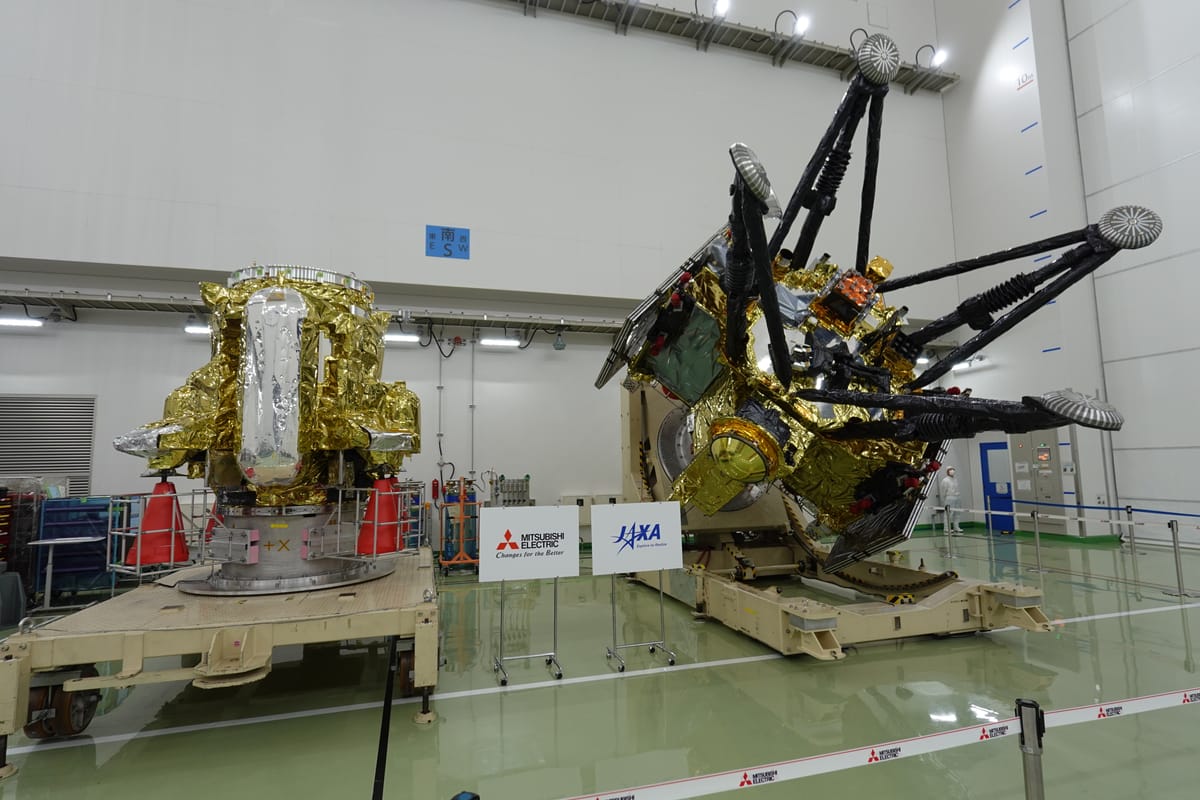
Japan's space agency is set to launch its Martian Moons eXploration (MMX) spacecraft on Monday (Oct. 19) at 3:41 p.m. EDT (12:41 p.m. PDT; 1941 UTC) on an H3 rocket from Tanegashima Space Center, according to JAXA.
In Japan, liftoff is at 4:41 a.m. JST on Tuesday (Oct. 20), the date JAXA uses in its launch schedule. The rocket, H3 flight No. 10, will fly from the Yoshinobu Launch Complex.
JAXA will stream the launch on its YouTube channel and on Niconico Live from about 55 minutes before liftoff to about 75 minutes after, according to its broadcast page. That's roughly 2:46 to 4:56 p.m. EDT (11:46 a.m. to 1:56 p.m. PDT; 1846 to 2056 UTC). The official livestream is embedded below.
As of Saturday (Oct. 17), JAXA's broadcast page listed the direct YouTube link as "coming soon." ESA says coverage will be in Japanese and English; JAXA's own broadcast page does not list a language. JAXA says the broadcast could be postponed, retimed or suspended, and that internet streams run slightly behind real time.
MMX is a sample-return mission to Phobos, one of Mars's two moons. JAXA plans to "collect a 10g sample through two soft-landing operations" and return it to Earth in 2031, with the capsule recovered in Australia. JAXA's launch plan (PDF, in Japanese) lists the spacecraft's launch mass as 4,480 kg.
According to ESA, MMX should reach Mars orbit in August 2027, release the 25 kg Idefix rover in early 2029, and land on Phobos in 2030. That landing falls within JAXA's 2027–2030 Phobos phase. Idefix comes from France's CNES and Germany's DLR, according to JAXA's launch plan.
"The data and samples returned by MMX are a window to study the evolution of Mars and the Solar System," ESA MMX project scientist Elliot Sefton-Nash said in an ESA release.
The rocket flies in the H3-24L configuration, with two LE-9 main engines, four SRB-3 solid boosters and a long fairing, per JAXA's launch plan. The plan's flight timeline assumes the Oct. 20 JST launch date, and JAXA notes that later events shift with the date:
- 3:41 p.m. EDT (12:41 p.m. PDT; 1941 UTC): liftoff
- About 3:43 p.m. EDT (12:43 p.m. PDT; 1943 UTC): the four solid boosters separate, just under two minutes into flight
- About 4:52 p.m. EDT (1:52 p.m. PDT; 2052 UTC): MMX separates onto a Mars transfer orbit, 592 km up
JAXA's flight-sequence animation shows each step.
If Monday's attempt slips, JAXA has reserved Oct. 21 to Nov. 7, Japan time, and says the launch time may vary in that period. It has not published reserve-day times.
A Japan Coast Guard navigational warning covers reserve days through Nov. 7 with a launch band of about 4:30 to 6:30 a.m. JST. That is a maritime hazard notice, not a JAXA launch time, and the Coast Guard tells mariners to check NAVTEX warnings for the latest reserve-day times.
For US viewers, that hazard band falls the previous afternoon: about 3:30 to 5:30 p.m. EDT (12:30 to 2:30 p.m. PDT; 1930 to 2130 UTC) through Oct. 31. US clocks fall back on Nov. 1, so from then through Nov. 6 it is about 2:30 to 4:30 p.m. EST (11:30 a.m. to 1:30 p.m. PST; 1930 to 2130 UTC).
After launch, ESA plans an image release confirming the launch on Oct. 20. MMX then begins a cruise of about a year, with Mars orbit insertion expected in August 2027.