Anthropic's junior tech hiring share falls from 27% to 9%
Anthropic says it tripled in size, so the number of junior hires may not have fallen, and its interviewers now write more about judgment.

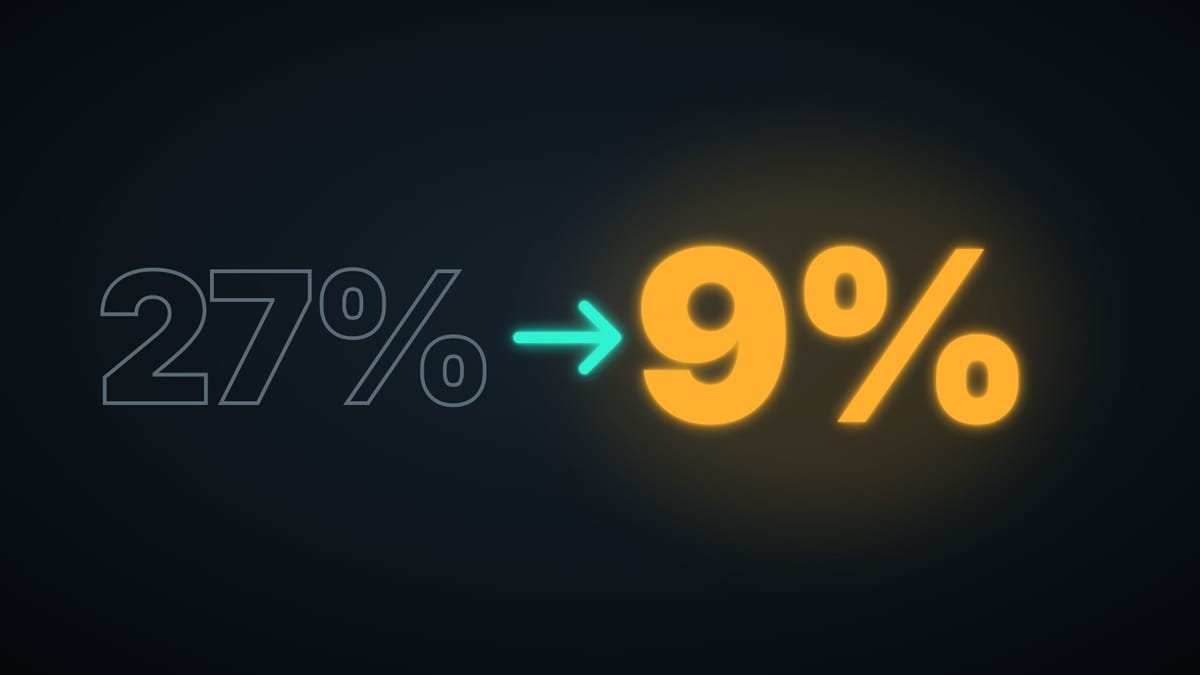
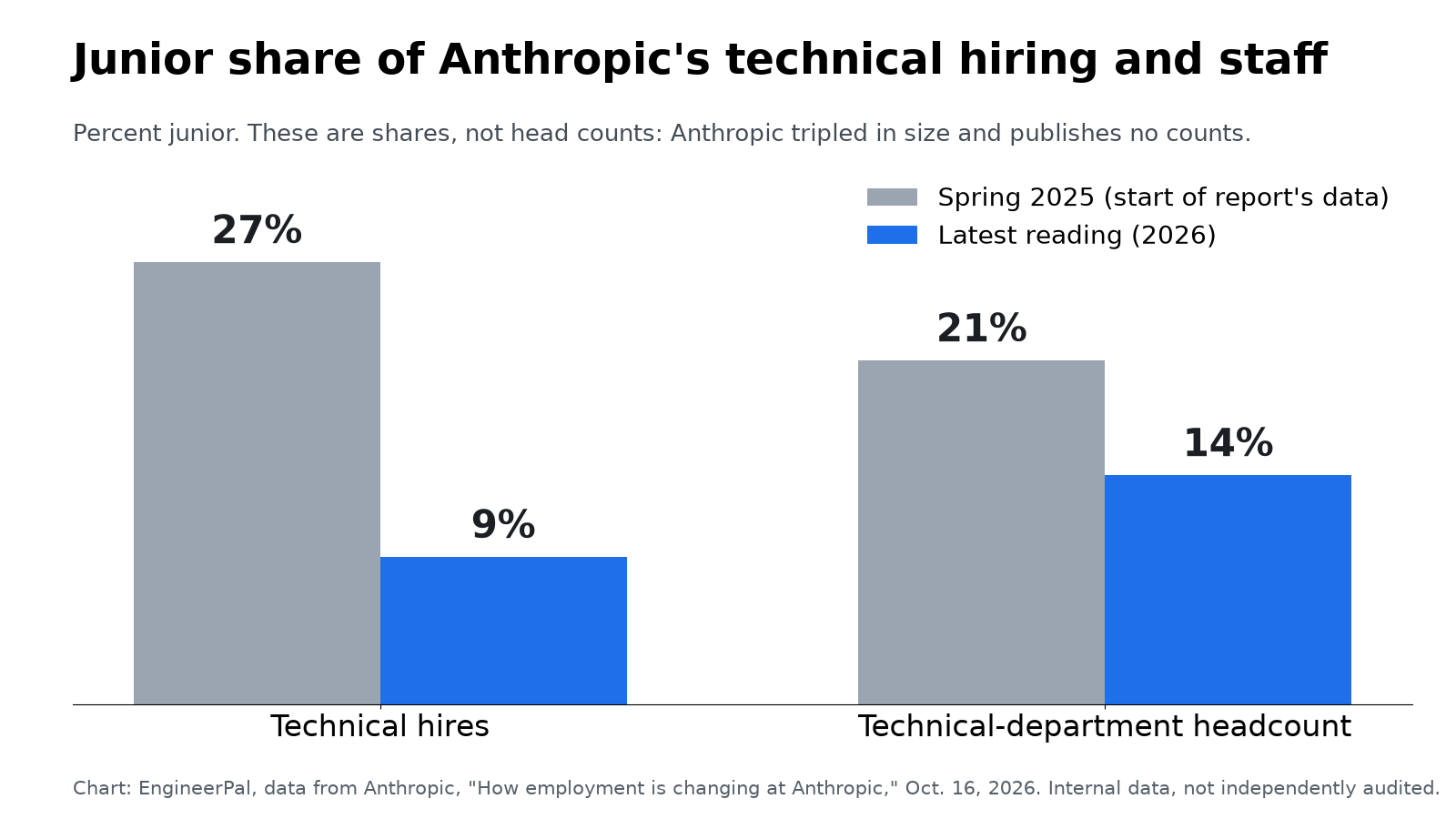
The junior share of Anthropic's technical hires fell from 27% to 9% over roughly a year, the AI company said Friday (Oct. 16) in a technical report on its own workforce.
That's a steep drop, but it's a drop in share, not necessarily in people. Anthropic says it tripled in size in the last year, and it doesn't publish how many junior people it hired, so the number of junior hires may not have fallen at all.
The figures cover only Anthropic's own technical departments, such as engineering and research, not the rest of the company or the wider industry. They come from Anthropic's internal hiring and HR records, which no outside party has independently checked, and the report doesn't define exactly who counts as junior.
For job seekers, the more useful part of the report is what Anthropic's interviewers now write down about candidates. Comments on autonomy and judgment rose the most, and mentions of a candidate's track record with AI tools tripled for technical roles.
The report comes from the Anthropic Institute, written by Nathan Wilmers, Regina Catipon, Maxim Massenkoff and Peter McCrory. It tracks two related numbers. The junior share of technical-department headcount slipped from 21% to 14% since early 2025.
"The proportion of junior technical hires fell even faster, from 27% to 9%," the authors wrote. In the report's first chart, that hires line runs from roughly May 2025 to mid-2026.
Postings for junior roles "have fallen particularly sharply since December 2025," the report said; its chart tracks juniors' share of open roles. By April 2026, it added, engineering and research teams "had deemphasized hiring for lower band technical positions."
The share math matters because Anthropic's total hiring grew so fast. The company says "technical hiring has continued growing in absolute terms," even as sales, finance and recruiting hired at a faster pace. Technical departments' share of all employees fell from 61% to 56% over the past year.
A smaller slice of a much bigger hiring pool can still mean a steady or growing number of junior hires. The report doesn't say which happened. It also doesn't disclose how many hires sit behind the 27% and 9%, and percentages built on small groups can swing sharply.
What the report doesn't claim
The report describes the shift in Anthropic's hiring mix. It doesn't claim to prove what caused it, and its authors say many of the company's practices can't be replicated across the economy. They also flag selection bias in a separate part of the report that measures productivity.
The report's summary says the shift "occurred as hours worked by AI agents relative to employees rapidly expanded," but it doesn't test whether one caused the other.
In an internal April 2026 survey of Anthropic's managers, "around a third of ML and a fifth of SWE managers reported hiring less due to AI," the report said, without giving a sample size. ML and SWE mean machine learning and software engineering. That's what managers said about their own hiring, not a finding about what caused the drop.
Anthropic isn't presenting the slowdown as solved, either. Its policy responses, including an internal early warning system for at-risk roles and a priority on internal redeployment, are aimed at current staff.
"Employment protections for incumbents will not benefit those not hired to begin with," the report said. The authors call for government retraining and income support.
It's also one fast-growing AI lab. For a broader read, NACE's spring 2026 employer survey of 185 US employers found that more than one-third of entry-level jobs require AI skills. NACE concluded that AI is largely reshaping, not replacing, early-career talent.
What Anthropic's interviewers now screen for
To see what hiring managers value, Anthropic used an automated coder (software that sorts text into categories) on interview scorecards for thousands of people hired since 2024. For technical candidates, "the single biggest increases were in comments on applicants' autonomy and judgment," the report said.
Discussion of domain expertise, meanwhile, shrank as a share of those technical assessments. For non-technical candidates, comments on customer and mission orientation increased while discussion of execution skills fell.
AI tools are the other big shift. In 2024, hiring managers noted candidates' track record on AI tooling in around 5% of assessments for technical roles and 7% for non-technical roles. By 2026, those rates had tripled and quadrupled, respectively, the report said, without giving the exact 2026 figures.
These are changes in what interviewers comment on, not a formal rubric change. Still, the report states the direction plainly: "Increasingly, hiring managers assess applicants based on their judgment and commitment, rather than the domain-specific skills and execution automated by AI tools."
"I expect models to continue to be jagged, so for my team I want them to be fungible across domains," one manager quoted in the report said. Put simply, that manager wants people who can move between problem areas.
If you're interviewing for technical roles, bring concrete examples of calls you made on your own, since autonomy and judgment drew the biggest increase in Anthropic's interviewer comments. Be ready to walk through your track record with AI tools, too, which those interviewers now note three times as often as they did in 2024.
The report publishes no junior head counts and no precise definition of junior. Until those numbers exist, the 9% describes Anthropic's hiring mix, not a count of closed doors.