Gemini 4 Argon vs Opus 5.5 vs GPT-6 Astra: benchmarks, price, limits
Argon costs half as much as Opus 5.5 through Nov. 30 and guesses far less in independent tests, but Pro users say its quota runs out fast.

Google's Gemini 4 Argon, the newest of the three top-tier AI models, costs half as much as Claude Opus 5.5 and a fifth as much as OpenAI's GPT-6 Astra through Nov. 30, according to Google's pricing page.
The catch is less about price than about how Argon behaves and how much of it you can use. Independent tests show it declines to answer far more often than GPT-6 Astra, and paying Gemini subscribers are complaining that its quota runs out fast. Here's how the three compare on what's published so far.
| Gemini 4 Argon | Claude Opus 5.5 | GPT-6 Astra | |
|---|---|---|---|
| Released | Limited access from Sept. 30 (per Artificial Analysis); generally available Oct. 13 | Sept. 22 | Sept. 3 |
| API price per 1M tokens (input/output) | $2/$10 until Nov. 30, then $4/$20 | $4/$20 | $10/$50 ($20/$75 over 272K input) |
| Batch price | $1/$5, then $2/$10 | $2/$10 | $5/$25 |
| AA-Omniscience hallucination rate | 15% (high) | Not found | 51% (max) |
| AA-Omniscience accuracy | 50% (high) | 66% (Max) | 63% (max) |
| Published app usage numbers | None | None | 5–45 local messages per 5 hours in Work and Codex (Plus estimate) |
Gemini 4 Argon release date and availability
Argon has two dates. It first rolled out to selected users on Sept. 30, according to Artificial Analysis, which tested it then. Google made it generally available on Tuesday, Oct. 13, in a blog post published at 12 p.m. ET.
Argon (gemini-4-argon) runs on the Gemini API's paid tier in AI Studio and Android Studio, and there is no free API tier, according to Google's pricing page. In the Gemini app and AI Mode in Search, it's limited to Google AI Pro and Ultra subscribers, per Google's blog post.
In Antigravity, Google's coding tool, Argon launched for Ultra only. A Google forum moderator posted on Oct. 16 that it "is now available to paid Pro plan subscribers."
Anthropic released Claude Opus 5.5 on Sept. 22. It's on the Claude API as claude-opus-5-5 and on Pro, Max, Team and Enterprise plans.
OpenAI launched GPT-6 Astra on Sept. 3 for the API, Azure and AWS Bedrock, and for ChatGPT Plus, Pro, Business and Enterprise. Plus users get Astra only in Work and Codex, not in Chat.
Gemini 4 Argon price vs Opus 5.5 and GPT-6 Astra
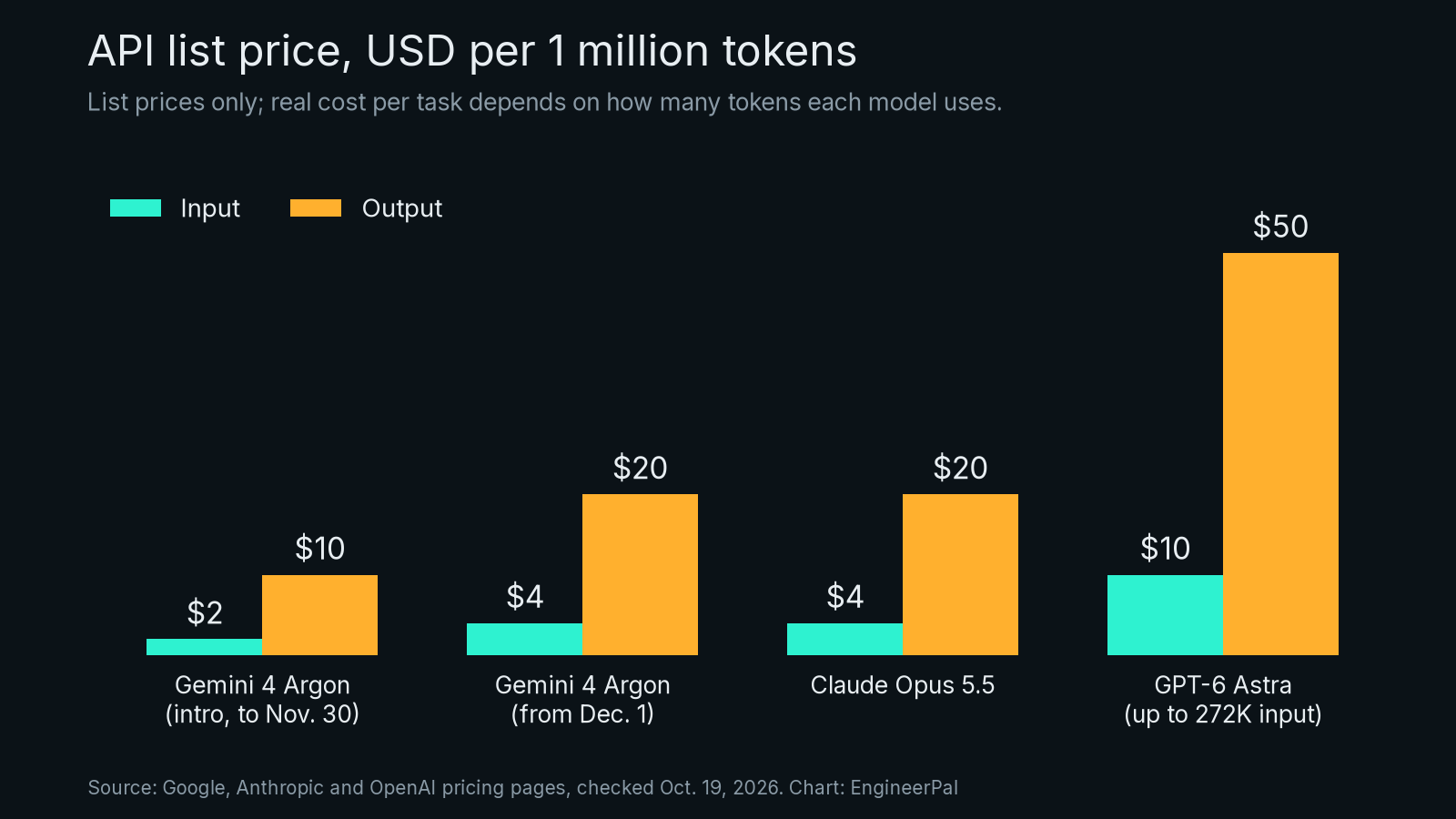
Argon's intro API price is $2 per 1M input tokens and $10 per 1M output tokens, including thinking tokens, through Nov. 30. From Dec. 1, it doubles to $4 and $20, according to Google's pricing page and launch post. Batch drops to $1 and $5 during the promo, then $2 and $10.
That later price matches Opus 5.5, which lists at $4 and $20 with one rate across its 1M-token context window. GPT-6 Astra is the priciest at $10 and $50. Prompts over 272K tokens cost 2x for input and 1.5x for output on the whole request.
Token use matters as much as list price. Argon averaged 62,000 output tokens per task on Artificial Analysis's Intelligence Index tests, against 27,000 for Astra, the independent benchmarker said.
So Argon cost $1.99 per index task at the intro price, compared with $3.26 for Astra (max). At standard pricing, Artificial Analysis said, Argon's cost rises to $3.98, about 1.2x Astra's.
Gemini 4 Argon benchmarks vs Opus 5.5 and GPT-6 Astra
The benchmark scores in this section are vendor-reported. Each lab reports its own numbers, and the labs often score each other's models differently. Google's model card compiles every column itself, rivals included, and doesn't list effort settings for each row.
On Google's numbers, Argon leads the Vals Index at 68.9%, ahead of Opus 5.5 at 67.0% and Astra at 63.1%. It also leads AutomationBench (51.3%) and the long-context GraphWalks test (84.2%). But Google's own table shows Argon trailing on Terminal-bench 4.0, FrontierSWE v2, Terminal-Bench Science and OSWorld-2.0.
Opus 5.5 tops Google's Terminal-bench 4.0 row at 66.4%, which matches the score Anthropic reported at its xhigh effort setting. Astra leads FrontierSWE v2 at 65.5%, according to Google's card.
Some figures don't line up. Google lists Astra at 34.2% on Agent's Last Exam, while OpenAI reports 59.3%, "the maximum at any effort." Google puts Opus 5.5 at 66.3% on Chartography; Anthropic reports 89.0% with tools.
Artificial Analysis, which runs its own tests, scores Argon (high) and Astra (max) level at 53 on its Intelligence Index. Its article doesn't give an Opus 5.5 score on that index.
Gemini 4 Argon vs GPT-6 Astra on hallucinations: cautious by design
Artificial Analysis's AA-Omniscience asks 6,000 factual questions without tools. Its hallucination rate measures how often a model answers wrongly when it doesn't know the answer, instead of declining. It isn't an overall error rate.
Argon's hallucination rate is 15%, against 51% for Astra (max), Artificial Analysis said. Argon "is much more likely to acknowledge when it does not know an answer rather than guess incorrectly," it said.
The tradeoff is accuracy. Argon answered 50% of questions correctly, against 63% for Astra, so their overall Omniscience Index scores are close: 42 for Argon and 43 for Astra. Artificial Analysis tested Argon on Sept. 30, before general availability.
As of Oct. 19, Opus 5.5 (Max) leads the live leaderboard with an Omniscience Index of 46 and 66% accuracy. A cautious model suits work where a wrong answer is costly and there's a fallback, such as search or a human reviewer.
Usage limits: the catch with Gemini 4 Argon
None of the three companies publishes a fixed message count for its paid apps. Gemini app limits are "compute-based," refresh every 5 hours up to a weekly cap and carry no Argon-specific numbers, according to Google's help page.
In Antigravity, Pro subscribers get "a separate weekly-only Argon quota" with no 5-hour refresh, the Google moderator wrote. Google's plans page says Ultra gets "the highest weekly rate limits," without numbers.
Claude's paid plans combine a 5-hour session limit with weekly limits, Anthropic says. With Opus 5.5, Anthropic said it is "increasing five-hour usage limits on Pro, Max, Team, and seat-based Enterprise plans."
OpenAI is the only one that gives a range. Plus users can expect 5 to 45 local GPT-6 Astra messages per 5-hour window, which OpenAI calls "estimates, not guaranteed."
Argon users are pushing back. "Results are good but the quota is terrible," one user replied to Google's Logan Kilpatrick, adding, "so back to opus 5.5 for now." A user on Google's forum asked for a rolling 5-hour limit for Pro users, saying that under the weekly-only quota "developers are left stranded for days."
One X post claims Argon gives "about 17x less usage than Opus 5.5 and 7x less than GPT-6 Astra" on paid plans. That's an unverified user claim with no published method, and Google hasn't published Argon quota numbers to check it against.
Argon's intro pricing runs through Nov. 30, and the $4 and $20 rates take effect Dec. 1.
Prices checked Oct. 19, 2026, 5:11 a.m. ET.