How axial-flux motors give the Mercedes-AMG GT 63 SUV 1,153 hp
Only the GT 63 and GT 55 get the three disc-shaped YASA motors, and Mercedes still hasn't set a US price or EPA range.

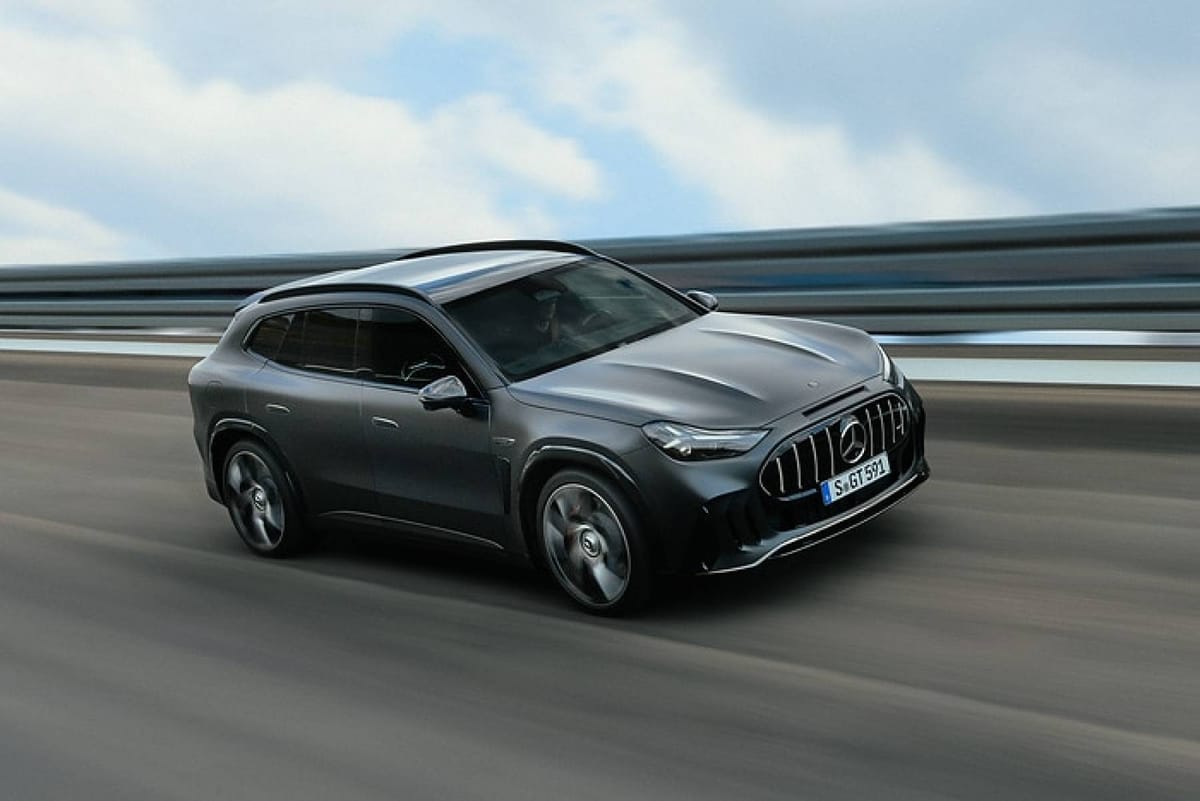
Mercedes-AMG revealed the electric GT SUV on Oct. 17, and its top GT 63 version makes 1,153 hp (860 kW; 1,169 PS in Europe) and 1,475 lb-ft of torque, according to Mercedes-Benz USA and the global release. The global release prints "1,169 hp," but by our math that's metric horsepower (PS) for the same 860 kW.
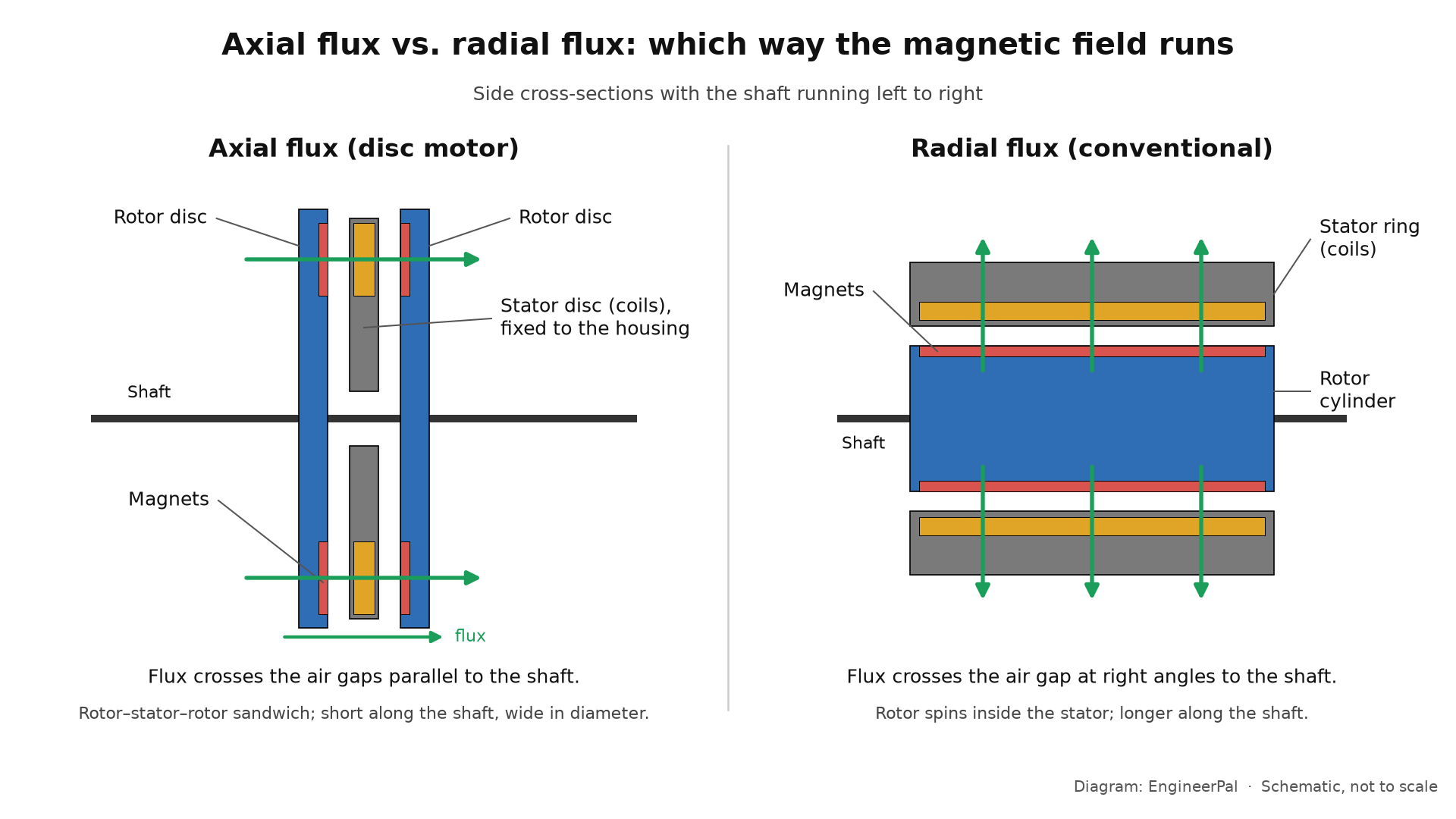
The power comes from three axial-flux motors, thin disc-shaped motors based on technology from YASA, the British company Mercedes bought in 2021. In these motors, the magnetic field runs parallel to the shaft instead of outward from it, which lets more torque fit into a smaller, lighter package.
Only the GT 63 and GT 55 get them. The GT 53 uses two conventional permanent-magnet synchronous motors, Mercedes said. There's no US price, no EPA range and no UK price yet.
How an axial-flux motor works
Most EVs use radial-flux motors, where a cylindrical rotor spins inside a ring-shaped stator (the fixed part that carries the copper coils). The magnetic flux crosses the gap between them outward from the shaft, at right angles to it.
In an axial-flux motor, "the electromagnetic flux … runs parallel to the motor's axis of rotation," Mercedes-AMG said. "Two rotors enclose the stator like a sandwich on the left and right," an arrangement it calls an H-configuration.
YASA stands for "Yokeless And Segmented Armature," a name taken from the title of the 2007 IEEE paper that introduced the design. The stator has no iron back ring (the yoke). It's built from separate segments, each with its own coil, and YASA says dropping the yoke cuts stator iron mass "by up to 80%."
In that paper, Tim Woolmer and Malcolm McCulloch of the University of Oxford wrote that it "has no stator yoke, a high fill factor and short end windings which all increase torque density and efficiency of the machine." Short end windings mean less copper that adds weight and heat without making torque.
The bigger win is leverage. "Torque is Force x Radius, so the increased radius of an axial machine immediately increases the figure," YASA said. Torque in a radial motor scales roughly with diameter squared times length, while an axial motor's scales with diameter cubed, Francesca Nava wrote in a 2023 Politecnico di Milano master's thesis.
How Mercedes packs three motors into the SUV
The rear drive unit "combines two axial flux motors, each with a compact input planetary gearbox, within a single housing," and the motors and gearboxes are oil-cooled, Mercedes said. Each rear wheel gets its own motor, which allows torque vectoring (shifting power between the left and right wheels).
The front motor is a "booster motor" that engages only when extra power or traction is needed. A disconnect unit decouples it under light load to save energy, according to the same release. Jochen Mager, Mercedes-AMG's head of product management AMG and portfolio intelligence, covers the motors, suspension and battery in an official walkaround video.
The thin discs are what make that layout fit. In the GT 4-Door Coupé, which shares the motors, each rear unit is about 80 mm wide and the front about 90 mm, and they rev to 13,000 and 15,000 rpm, Autocar reported.
Mercedes builds the motors at its Berlin-Marienfelde plant. About 65 of roughly 100 production processes are new to Mercedes and 35 are world firsts, the company said.
The numbers, and which ones are preliminary
Mercedes' footnotes say its charging-power figures "are preliminary" and not yet certified, and its US acceleration times are marked as estimates. Its WLTP ranges carry a different footnote, which says only that real-world range may differ.
| GT 63 | GT 55 | GT 53 | |
|---|---|---|---|
| Motors | 3 axial-flux | 3 axial-flux | 2 conventional |
| Peak output | 1,153 hp | 805 hp | 536 hp |
| Continuous output | 711 hp | 711 hp | 362 hp |
| Torque | 1,475 lb-ft | 1,372 lb-ft | 590 lb-ft |
| 0-60 mph (est.) | 2.6 s | 3.0 s | 4.1 s |
| WLTP range (Mercedes figure) | 385–435 mi | 385–435 mi | 371–415 mi |
GT 63 and GT 55 ranges are for the 128 kWh pack. With a 1-foot rollout, the GT 63's estimated 0-60 time drops to 2.4 seconds. The 128 kWh pack's preliminary DC charging peak is 710 kW, with 10% to 80% in a claimed 12 minutes.
WLTP is Europe's test cycle and usually reads higher than the EPA's, and Electrek said to "expect lower EPA numbers."
The continuous figure matters for heat. The GT 63's 711 hp (530 kW) of continuous output is about 62% of its peak, by our math. That's the whole drivetrain, limited by the battery and inverters as well as the motors.
Mercedes hasn't published per-motor specs. In 2024, YASA said the motor it developed for AMG's electric cars weighs 24 kg and makes up to about 353 kW, Autocar reported. Those figures aren't confirmed for this car.
The companies' weight claims don't agree. Mercedes says in its Concept AMG GT XX press release, posted on YASA's site, that axial-flux motors are "around two-thirds lighter" with "around three times" the power density, while YASA's site says they're "50% lighter" with up to 4 times the torque.
The trade-offs
Axial motors are harder to build. Magnets pull the rotor discs hard toward the stator, and a rotor offset "may cause significant unbalanced axial forces," researchers at Poland's Opole University of Technology and UK EV maker Arrival wrote in a 2020 study in Energies.
Wide rotors also strain at speed. A larger rotor diameter "generates a significant centrifugal force at high rotational speeds, which could potentially dislodge the magnets," Nava wrote.
Precision is the price of low weight. Writing about YASA's lab prototypes, Automotive Manufacturing Solutions said every gram removed "has to be recovered from tighter tolerances rather than simpler design." A 2021 IEEE comparison of two axial designs for a student racing car, led by University of Kentucky researchers, concluded that "the choice is application specific."
Mercedes hasn't published what the motors cost. It uses them only in AMG.EA performance models, and the GT 53 makes do with conventional motors.
When you can buy one
The GT 53 can be ordered in Germany from Oct. 20 at €113,050 including VAT, with the GT 63 and GT 55 following in spring 2027, Mercedes said. UK prices will come "in the coming months," Autocar reported.
In the US, the GT SUV arrives at dealerships in summer 2027 as a 2028 model, Mercedes said, with no price or EPA range yet. Fast charging will be the catch, according to Electrek Editor-in-Chief Fred Lambert, who wrote that there's "almost nowhere to charge at 710 kW today."