How SpaceX's Starfall capsule brings experiments back from orbit
Starfall has no engine, so its rocket starts the trip home, and a heat shield and three parachutes do the rest before a Pacific splashdown.

SpaceX is targeting Monday (Oct. 19) at 6:30 a.m. EDT (3:30 a.m. PDT; 1030 UTC) for a Falcon 9 launch of Bandwagon-5, a rideshare mission carrying 32 payloads, according to SpaceX's mission page. The last item on its deployment timeline, nearly three hours after liftoff, is Starfall, SpaceX's uncrewed capsule for bringing experiments and cargo back from orbit.
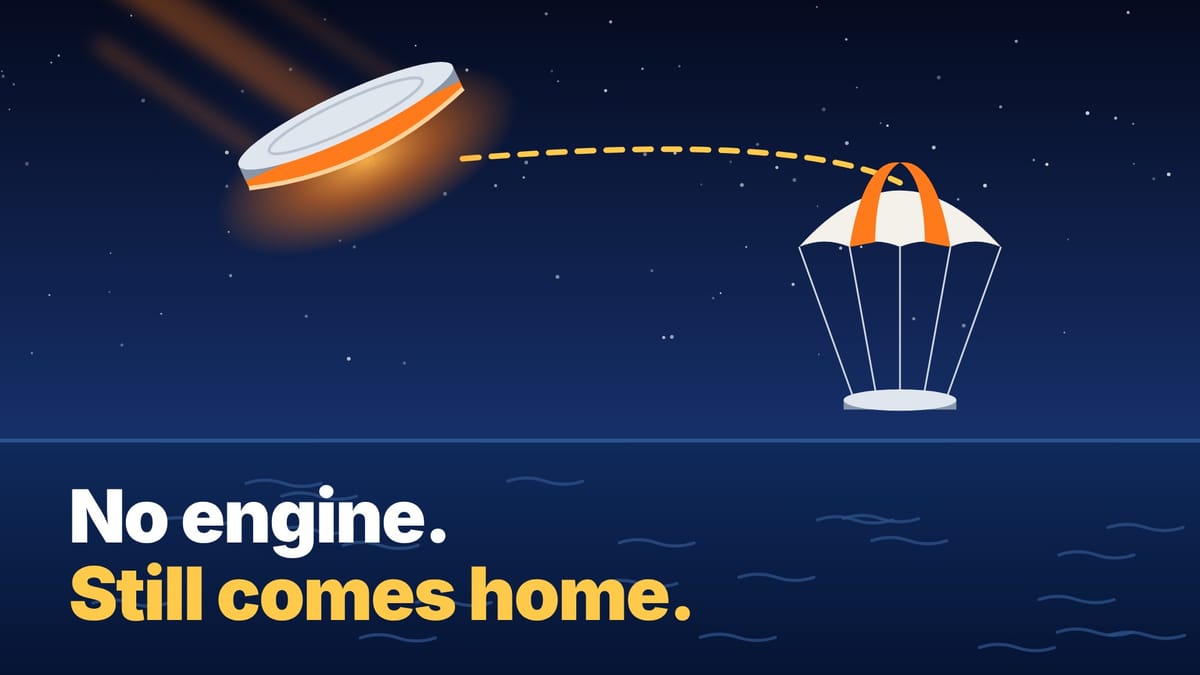
Starfall is a flat disc about 3.1 meters (10.2 feet) wide with no engine, according to the Federal Aviation Administration's environmental assessment. It can only change which way it faces, so it depends on its rocket to start the trip home. A heat shield handles reentry, and parachutes lower it to a Pacific splashdown.
What we don't know: SpaceX hasn't said whether this Starfall carries a customer payload, whether the capsule is new, or exactly when and where it will splash down. Its webcast may not show the deployment or reentry. Confirmation that the capsule was recovered may take days.
Monday's flight is Starfall's second demonstration mission, according to launch tracker Next Spaceflight. SpaceX's mission page doesn't use that label, but the FAA's review covers two demonstration reentries.
A disc on top of the payload stack in a photo SpaceX posted Saturday (Oct. 17) is Starfall, according to Ars Technica's Stephen Clark, who called it "the cake-topper for SpaceX's Bandwagon-5 mission." SpaceX's own caption mentions only the 32 payloads.
What Starfall is
The FAA describes Starfall as a "cylindrical shaped capsule approximately 0.75 meters (2.5 feet) tall with a diameter of 3.1 meters (10.2 feet), weighing approximately 2,100 kilograms (4,600 pounds)." It can carry up to 1,000 kilograms (2,200 pounds) of payload and is "not designed or intended for human spaceflight," the document says.
It comes in two halves: an aluminum top plate weighing about 1,400 kilograms and a carbon-fiber heat shield weighing about 700 kilograms, according to the FAA. The heat shield holds two 151-liter tanks of compressed nitrogen. Cargo rides in the top plate, Space.com's Mike Wall reported.
The FAA lists two goals: to "enable point-to-point delivery of critical cargo through space on rapid timelines" and to build a commercial in-space manufacturing market by offering "access to microgravity and vacuum, loiter on orbit, and safe return from orbit as a service at scale." It can launch on Falcon 9 or Starship.
How Starfall gets home
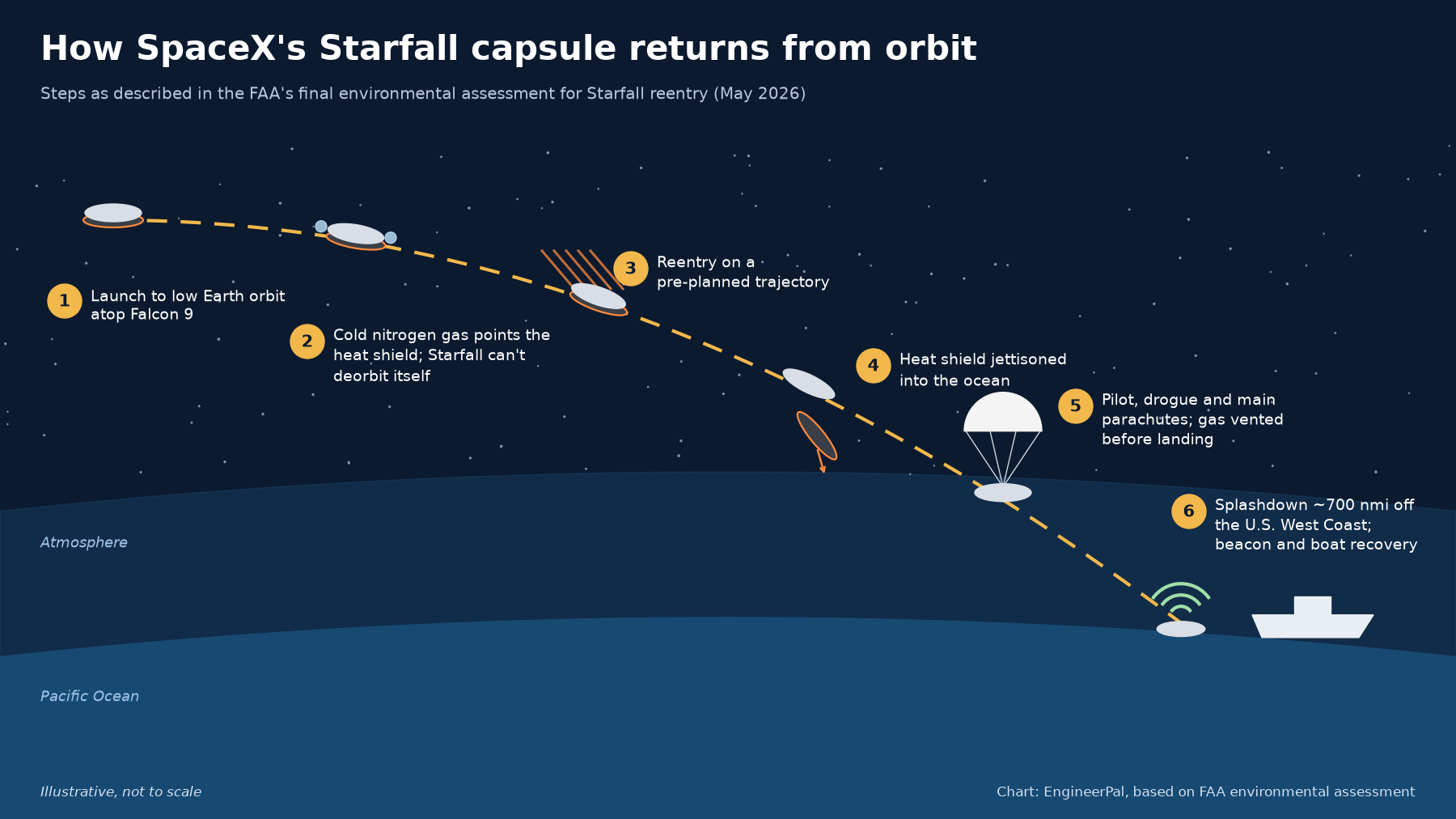
"Capsules do not have the ability to de-orbit themselves and can only control their attitude," the FAA document says. Starfall uses its compressed nitrogen for small maneuvers, "such as pointing the capsule's heat shield in the correct direction to safely re-enter Earth's atmosphere."
On the first demo in June, the rocket did that job: Falcon 9's second stage carried Starfall for about 1.5 orbits, then "deorbited itself and the Starfall capsule" before releasing it, NASASpaceFlight reported. SpaceX's Bandwagon-5 timeline lists no deorbit burn, so the timing for Monday isn't public.
The FAA says the heat shield is jettisoned into the ocean during reentry and the two halves separate. A small pilot parachute pulls out a drogue parachute for stability, and a main parachute brings the capsule down. The same nitrogen also pressurizes the payload volume, jettisons the heat shield and fires the parachute mortar.
Before landing, the capsule vents its remaining gas so nothing aboard is pressurized, leaving it "passively safe," the FAA says. Splashdown is planned for international waters about 700 nautical miles (1,300 kilometers) off the U.S. West Coast, with a reentry window of about 30 minutes.
A locator beacon guides a recovery ship up to 200 feet (61 meters) long and smaller inflatable boats to the capsule. SpaceX "would recover vehicle components, including parachutes and heat shields, to the maximum extent practicable," the FAA says. If recovery fails, the parts sink.
What happened on the first flight
The first Starfall demo lifted off June 23 at 6:53 a.m. EDT, according to SpaceX. SpaceX said on X that the vehicle "will enable affordable, routine access to the microgravity environment for scientific research and in-space manufacturing." That's the company's own description.
SpaceX cut its webcast about 10 minutes after liftoff, "a practice usually associated with national security missions," Space.com's Wall wrote. SpaceX posted "Deployment of Starfall confirmed" at 10:01 a.m. EDT, about three hours after launch, and never officially announced the splashdown.
The capsule splashed down about 1,300 kilometers off the West Coast, NASASpaceFlight reported. Three days later, photographer Magnus Bergheim showed it arriving at the Port of Long Beach aboard the recovery vessel Shannon, the San Antonio Express-News reported.
One known passenger was Starbase Brewing, an Austin brewery unaffiliated with SpaceX, which flew brewing, distilling and wine yeasts plus native Texas seeds. "We've received our Starfall Demo capsule back from @SpaceX. All of the yeast containers are still in perfect condition," the brewery posted July 22.
Who wants to fly on it
Redwire's SpaceMD unit has signed for a Starfall mission planned for 2028 carrying "up to 32" of its PIL-BOX drug-crystallization labs, Redwire said in August. Redwire calls it "the largest dedicated commercial microgravity research mission flown to date." No customer payload has been announced for Monday's Starfall.
The same rocket carries a competitor. Varda Space Industries' W-Series 7 capsule is scheduled to deploy about 66 minutes after liftoff, per SpaceX's timeline. Varda lands its capsules at the Koonibba Test Range in South Australia, SpaceNews reported.
How to watch Bandwagon-5
- Launch window: Monday (Oct. 19), 6:30–7:30 a.m. EDT (3:30–4:30 a.m. PDT; 1030–1130 UTC), from Space Launch Complex 40 at Cape Canaveral Space Force Station, Florida.
- Webcast: starts about 15 minutes before liftoff on SpaceX's mission page and its X account, around 6:15 a.m. EDT (3:15 a.m. PDT; 1015 UTC) for an on-time launch.
- Booster landing: about 9 minutes after liftoff, on the droneship A Shortfall of Gravitas in the Atlantic. It's the booster's 19th flight, SpaceX says.
- Starfall deployment: scheduled 2 hours, 48 minutes after liftoff, or about 9:18 a.m. EDT (6:18 a.m. PDT; 1318 UTC) if Falcon 9 launches at the window's opening.
- Weather: the Space Force's 45th Weather Squadron forecasts a 55% chance of favorable conditions, according to launch trackers including No Earlier Than.
- Backup: Tuesday (Oct. 20), same window.
Whether Monday's webcast will show any deployments is unknown, and SpaceX hasn't said it will cover Starfall's reentry. After the June flight, word of the capsule's return came from a port photo days later, not from SpaceX.
The FAA expects each Starfall recovery to keep vessels working for about five days, likely out of Los Angeles or San Diego County.