How the Tesla Roadster's cold-gas thrusters actually work
Tesla says the gas is nitrogen, about 250 kg of it in the Rocket, and by our math it lasts under 2 seconds at full thrust.

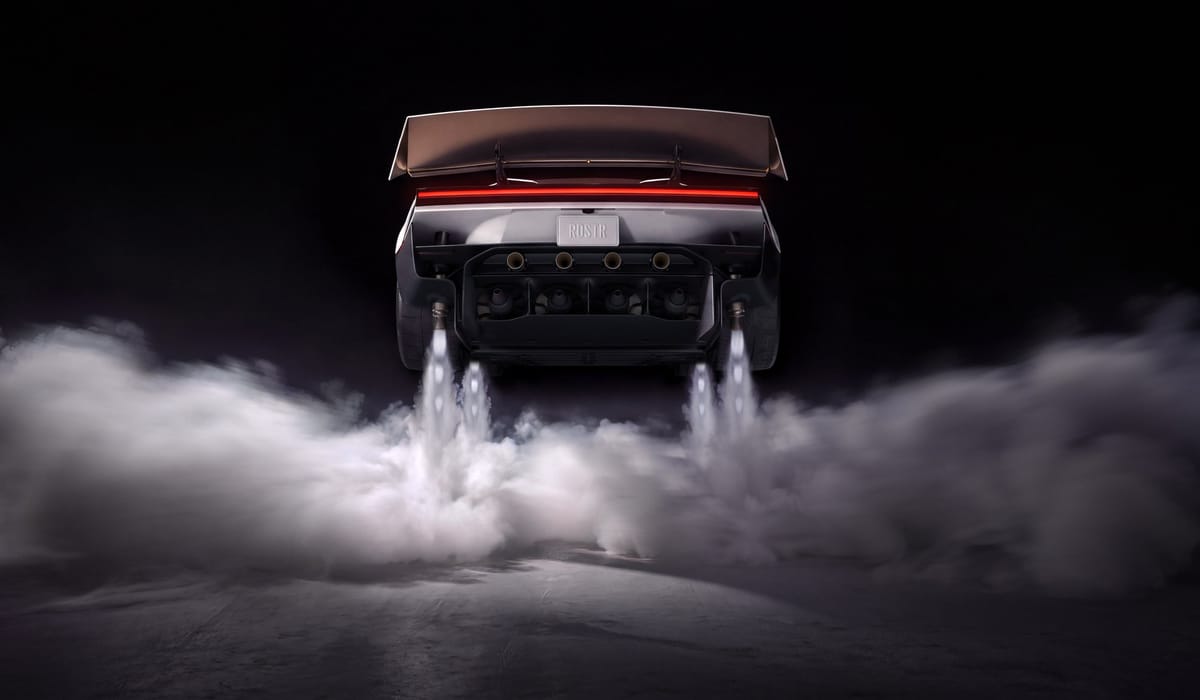
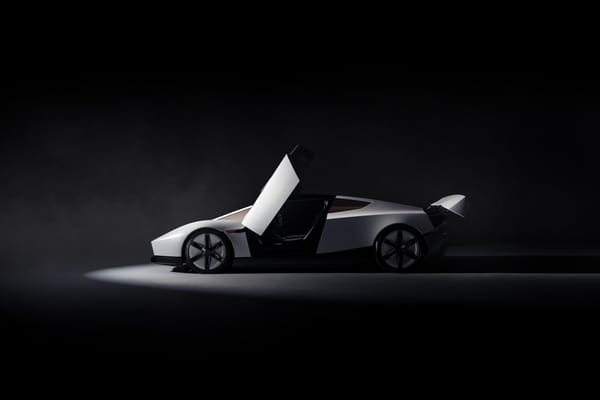
Tesla's second-generation Roadster flipped off a ramp and jumped five other Teslas at SpaceX's McGregor, Texas, test site on Oct. 15, as we reported from the reveal. The flying parts ran on cold-gas thrusters, the same basic hardware SpaceX uses to orient its Falcon 9 rockets.
A carbon-wrapped tank holds nitrogen at very high pressure, valves release it through nozzles, and the escaping gas pushes the car the other way. Nothing burns, so it's relatively safe and easy to control, but compressed gas stores little energy, so the push lasts seconds.
Tesla hasn't published the numbers that would show how well it works: operating pressure, curb weight, or whether its thrust figure is peak or sustained. It also hasn't announced a price.
How a cold-gas thruster pushes a car
A cold-gas thruster is about the simplest rocket there is: a pressurized tank, a valve and a nozzle that turns the gas's pressure into speed.
Musk said "air" on stage, but Tesla VP of vehicle engineering Lars Moravy described a high-pressure nitrogen system to Top Gear and Hagerty, InsideEVs reported.
SpaceX's Falcon user's guide said the second stage's nitrogen attitude-control system "is more reliable and produces less contamination than a propellant-based reaction control system."
Where the tanks and nozzles go
The gas sits in carbon-overwrapped pressure vessels (COPVs), light tanks wrapped in carbon fiber. The Thrust trim gets a 200-liter tank in place of the trunk, feeding 4 rear nozzles, according to InsideEVs and Top Gear.
The invite-only Rocket trim adds a 400-liter tank where the passenger seat would be, for 600 liters and 10 nozzles in all. Tesla said the stunt car's tanks held about 250 kg of gas, Car and Driver reported.
On the Rocket, 4 nozzles point backward for acceleration, 4 point down near the corners for lift and 2 at the nose fire sideways to turn the car, according to Electrek.
MotorTrend's look at the show car found titanium tubes and nozzles, splitters made of Inconel, a heat-resistant nickel alloy, and valve actuators reportedly borrowed from the ankle of Tesla's Optimus robot. Tesla's kickflip video shows the thrusters at work.
The numbers: Tesla's claims vs. our estimates
Moravy claimed the 4 rear nozzles make over 80 kilonewtons (kN), Electrek reported. He also said one fill of the Thrust trim's 200-liter tank gives about five seconds of boost, according to InsideEVs. Neither figure has been independently measured.
Those two claims can't both describe a full-power burn. The estimates below are EngineerPal calculations from Tesla's stated tank size and gas mass, not Tesla figures.
Start with pressure. Packing 250 kg into 600 liters means a density of about 417 kg per cubic meter. Nitrogen at room temperature (20 degrees Celsius) reaches that density at about 490 bar, or 7,100 psi, by our estimate (1 bar is roughly atmospheric pressure).
The tanks store gas at up to 10,000 psi, MotorTrend reported, and at that pressure 600 liters would hold nearly 300 kg. Tesla hasn't confirmed the actual fill pressure.
Next, burn time. Thrust equals mass flow times exhaust speed, and nitrogen expanding from 490 bar leaves the nozzle at roughly 680 meters per second at first, slowing as the tank empties and cools.
Averaged over the burn until the tank falls to 20 bar, we get 510 to 650 m/s, depending on how much heat the tank walls add back. That makes the Rocket's full load worth about 103 to 154 kN-seconds of impulse (thrust multiplied by time), before nozzle losses.
Divide by 80 kN and you get 1.3 to 1.9 seconds at full thrust from all 600 liters, by our estimate. The 200-liter Thrust tank holds about 83 to 99 kg, depending on whether it's filled to the same pressure or to the full 10,000 psi, so it would last roughly 0.4 to 0.8 seconds at 80 kN.
Spread over Moravy's five seconds, average thrust is only about 7 to 12 kN. Either 80 kN is a brief peak, or it describes the bigger Rocket setup. Tesla hasn't said which.
| Figure | Number | Source |
|---|---|---|
| Gas on board, Rocket (600 L) | About 250 kg | Tesla claim |
| Tank rating | Up to 10,000 psi | Reported by MotorTrend |
| Implied fill pressure | About 490 bar (7,100 psi) | EngineerPal estimate |
| Rear thrust | Over 80 kN | Tesla claim (Moravy) |
| Boost per fill, Thrust (200 L) | About 5 seconds | Tesla claim (Moravy) |
| Full-thrust burn, 600 L / 200 L | 1.3–1.9 s / 0.4–0.8 s | EngineerPal estimate |
| Ideal hover, 600 L | 5–9 seconds | EngineerPal estimate |
The hover figure assumes a 1,700 to 2,000 kg car (Tesla hasn't published a weight) and perfect throttling.
Why the thrusters need the fans, and what's unproven
Thrusters exist because tires run out of grip. Street tires manage roughly 1.0 to 1.2 g, which caps a tires-only 0-60 mph run at about 2.5 seconds, by our estimate.
Tesla's fan system sucks the car onto the road to raise that limit. "From zero to 50 [mph], when these wings aren't doing anything, we can hold over 2 g's in a corner," Moravy said in a Hagerty interview, as quoted by Car and Driver.
Outlets describe the 2 g figure differently. The Verge said the fans generate "up to two Gs of suction force," while Car and Driver says up to 2 g of downforce at 200 mph and less at lower speeds.
Even with suction, our estimate puts the traction limit at roughly 3 g if the full 2 g figure is available at launch, less if not: tires grip at about 1.1 times their load, and suction adds to that load.
Tesla claims 0-60 mph in under 1 second for Thrust, according to its website, and under 0.59 seconds for Rocket, per website tiers reported by The Verge. By our math, that's at least 2.7 g and 4.6 g on average; thrusters cover any gap.
Refilling is slow. Filling the 200-liter tank from an external nitrogen supply takes 2 to 6 hours today, and Tesla is targeting under 30 minutes, Moravy told Top Gear, according to InsideEVs.
Musk said the car is "just going to puff itself up," according to Car and Driver, which InsideEVs noted differs from the external-nitrogen refill Moravy described. By our estimate, compressing 250 kg of nitrogen to 490 bar takes at least 37 kWh, before real-world compressor losses.
TechCrunch noted that COPVs have been at the root of multiple SpaceX rocket explosions, and in the Rocket one sits where a passenger would. Tesla hasn't published burst or crash testing for the tanks.
Is a thruster car legal?
Tesla said on its website that the Rocket is "not approved for public road use," Car and Driver reported. The FAA said in a statement to CBS News that "the Tesla vehicle does not meet the FAA definition of an aircraft," and gave no public reasoning.
In a statement to CBS, NHTSA said "the manufacturer must ensure that it does not defy applicable Federal Motor Vehicle Safety Standards and drivers must obey all local traffic laws." It also said it "will continue to monitor the situation."
Federal law has carmakers self-certify that a vehicle meets those standards; NHTSA doesn't pre-approve cars. The rules apply to vehicles manufactured primarily for use on public roads, which in our reading is how track-only cars avoid certification.
Tesla hasn't said how it will classify the "Race Ready" Thrust trim. Asked whether the car would be street-legal, Musk said, "Depends on your street," according to Business Insider.
For now, buyers can reserve the Performance trim for $50,000 or the Thrust for $250,000, while the Rocket is invite-only. The payments are fully refundable, but Tesla said in its reservation terms that it "cannot guarantee when your vehicle will actually be delivered or if it will be delivered," according to Business Insider. Production is targeted for 2028.