DeepSeek refreshes V4.1 Flash, claims coding and agent gains
The MIT-licensed update keeps the same API price, but no independent lab has tested it yet and running it locally takes datacenter hardware.

DeepSeek posted new weights for its V4.1 Flash model on Hugging Face at 10:40 p.m. ET Friday (Oct. 16), and the company says the update scores higher on coding and agent benchmarks at the same API price.
The release, DeepSeek-V4.1-Flash-1017, is MIT-licensed for both code and weights and is live on DeepSeek's API, website and app. It refreshes the September launch of what DeepSeek calls the smallest model in its new architecture family.
"DeepSeek-V4.1-Flash-1017 is a minor update to DeepSeek-V4.1-Flash, delivering substantial improvements across reasoning, coding, agentic tasks, and visual benchmarks," DeepSeek said in its model card.
No independent lab had published 1017 results as of 11:30 a.m. ET Saturday (Oct. 17), so every score here is vendor-reported unless noted. Artificial Analysis measured the September build, not 1017, at 26.8% on Terminal-Bench 4.0 at max reasoning effort, against DeepSeek's self-reported 31.2.
The update has "the same architecture, config.json, tokenizer and prompt encoding as the launch checkpoint — only the weights change," the vLLM project, which makes open-source software for serving models, said.
On DeepSeek's 1017 table, DeepSWE v1.1 rises from 74.2 to 77.0, ProgramBench from 20.3 to 29.1, and Agents' Last Exam from 31.8 to 35.4.
The biggest jump, Terminal-Bench 4.0 from 31.2 to 42.3, comes with a caveat. The new changelog entry says that test used the Claude Code harness (the agent software that runs each task), while the September card says DeepSeek's coding-agent tests used DeepSeek Harness Minimal. DeepSeek hasn't said whether the setups match.
How it compares on benchmarks and price
DeepSeek's card compares 1017 against a column labeled "GLM-5.3," which is Z.ai's full GLM-5.3, not the closer rival, GLM-5.3-Flash. The table below uses each vendor's own scores for the benchmarks all three models report.
| Benchmark (vendor-reported) | DeepSeek V4.1 Flash 1017 | GLM-5.3-Flash | DeepSeek V4 Pro |
|---|---|---|---|
| DeepSWE v1.1 | 77.0 | 63.4 | 62.7 |
| Agents' Last Exam | 35.4 | 26.3 | 25.7 |
| AutomationBench v1.0.6 | 60.5 | 48.8 | 43.2* |
*DeepSeek's September V4.1 Flash card and Z.ai's GLM-5.3 card list 43.2 for V4 Pro; DeepSeek's own V4 Pro 0813 card lists 31.8 for "AutomationBench (Public)."
Each vendor used different harnesses, context limits and timeouts, so treat gaps of a few points as noise.
"The API calling method and pricing remain unchanged — simply use deepseek-flash to access the latest model," DeepSeek said in its changelog. Its pricing page lists $0.30 per million input tokens and $1.20 per million output tokens at peak, and half that off-peak, DeepSeek's discounted hours.
Peak hours are 9 p.m. to midnight ET Sunday through Thursday and 2 a.m. to 6 a.m. ET Monday through Friday. US business hours, Chinese public holidays and everything from 6 a.m. ET Friday to 9 p.m. ET Sunday are off-peak.
Z.ai lists GLM-5.3-Flash at $0.15 in and $0.50 out, and DeepSeek's pricing page still lists V4 Pro today, at $1.32 in and $3.96 out at peak. Per-token price isn't cost per task, since reasoning-token use varies widely.
The same release opened DeepSeek's Search & Fetch APIs at $0.75 per 1,000 successful calls each, with server-side calls through DeepSeek Harness, Claude Code or Codex free until Oct. 31 at 12:00 p.m. ET.
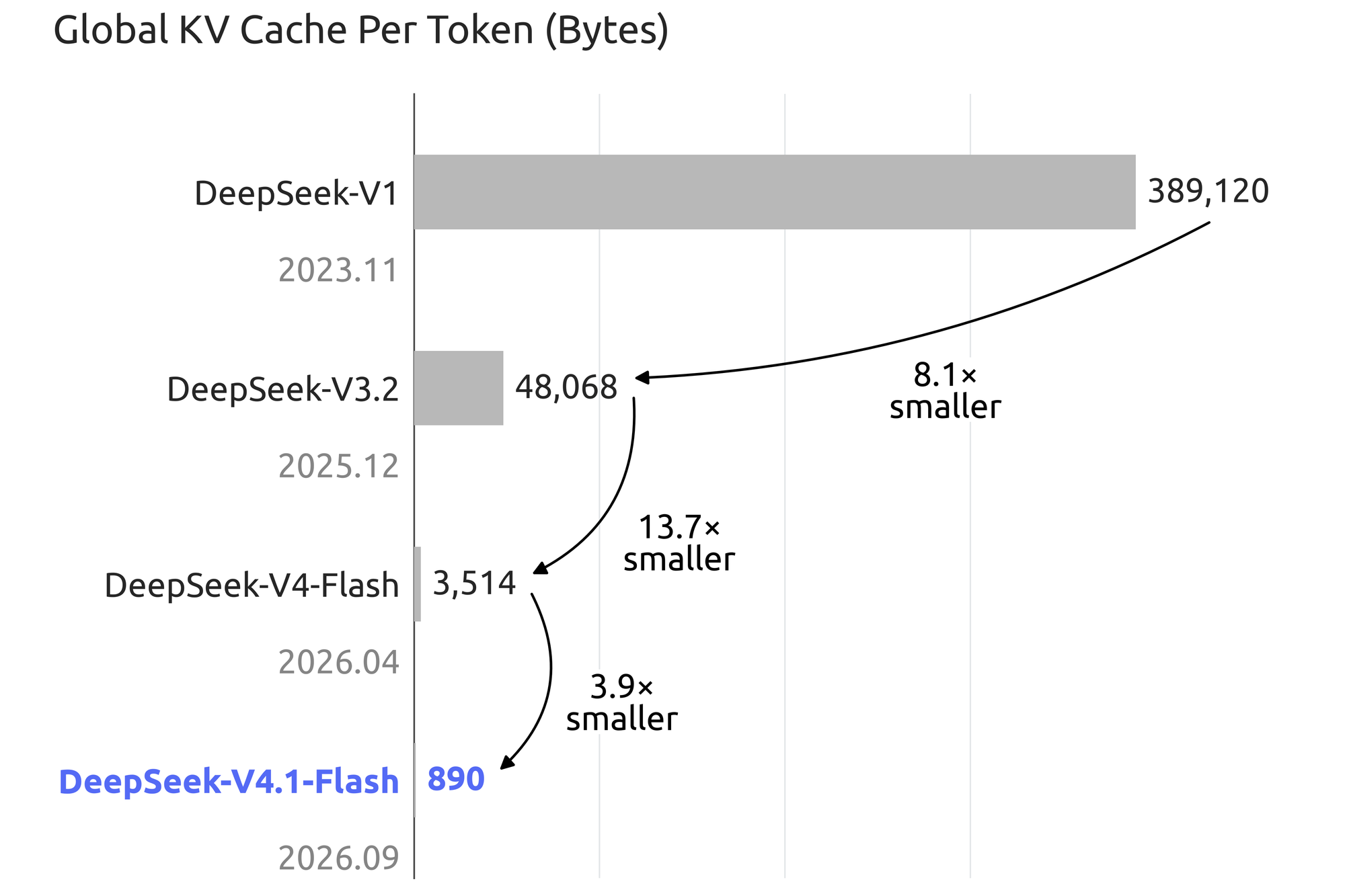
DeepSeek puts the model at 552B backbone parameters plus 196B of separately counted "Engram" memory tables, which the model looks up using short runs of input tokens, with 8B to 16B parameters active per token.
How to try or run it
The easiest free route is chat.deepseek.com or the DeepSeek app, which DeepSeek says runs 1017. OpenCode also offers V4.1 Flash free for a limited time as "DeepSeek V4.1 Flash Free" through its pay-as-you-go OpenCode Console model service (sign-in required).
That free tier is capped at 200K context, according to the models.dev registry. OpenCode hasn't said which snapshot it serves.
OpenRouter lists the model as deepseek/deepseek-v4.1-flash-1017. Its DeepSeek-hosted endpoint charges DeepSeek's prices, while third-party hosts in its standard routing start at $0.10 per million input tokens and $0.42 per million output tokens, some with smaller context or output limits.
Vercel AI Gateway carries the same model ID. A minimal OpenRouter request:
curl https://openrouter.ai/api/v1/chat/completions \
  -H "Authorization: Bearer $OPENROUTER_API_KEY" \
  -H "Content-Type: application/json" \
  -d '{"model": "deepseek/deepseek-v4.1-flash-1017", "messages": [{"role": "user", "content": "Hello"}]}'
Running it yourself takes datacenter hardware. The checkpoint, or saved set of weights, is roughly 511GB, and vLLM's guide puts the minimum at about 614GB of GPU memory, enough for one GB200 NVL4 tray or an 8x H200 node.
You need vLLM 0.31.0 or later. This minimal example for a single 8x H200 node uses tensor parallelism (TP8), which splits the model across all eight GPUs, plus the tokenizer flag the repo requires (it ships no chat template) and DeepSeek V4.1's reasoning parser:
pip install -U "vllm>=0.31.0"
vllm serve deepseek-ai/DeepSeek-V4.1-Flash-1017 \
  --tensor-parallel-size 8 \
  --tokenizer-mode deepseek_v41 \
  --reasoning-parser deepseek_v41
That's a minimal example, not the guide's recommended setup, which defaults to four GPUs on H200 and two on Blackwell chips by moving the Engram memory tables to host RAM. Its hardware figures were measured on the September checkpoint.
SGLang, another serving engine, needs a preview Docker image, and mainline llama.cpp doesn't support V4.1 yet. A community GGUF build from an unmerged branch is text-only, and its smallest quantized (compressed) version is 246GiB.