Google DeepMind's Genie 4 world model adds sound and live steering
Scenes now hold together for about two minutes, but only trusted testers can use it. Google AI Ultra subscribers are next.

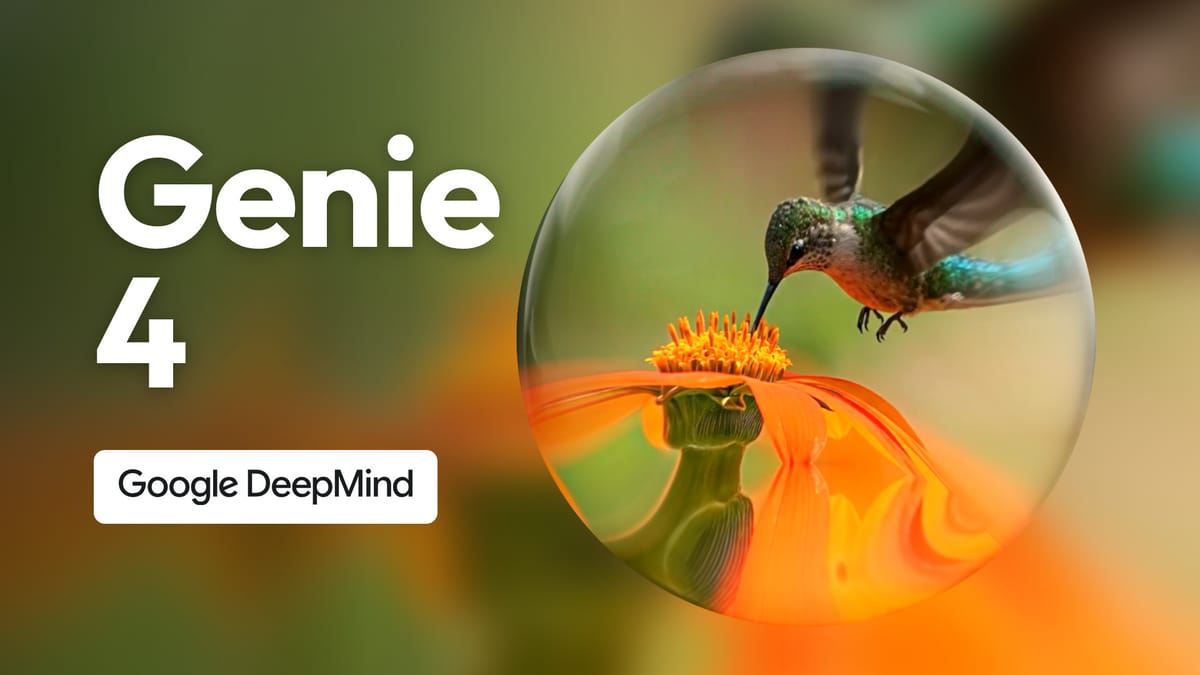
Google DeepMind announced Genie 4 on Tuesday (Oct. 27), a new version of its world model that generates interactive scenes in real time and, for the first time, creates their sound as it goes, from wind and music to dialogue.
For now, Genie 4 is a research preview for a small group of trusted testers. Google says it's "coming soon" to Google AI Ultra subscribers in Project Genie and to early access partners of the Gemini API and Google AI Studio. There's no price or release date.
A world model works differently from a video generator. You don't get a finished clip. You get a scene you can move through with the keyboard while the model keeps drawing what happens next.
Genie 4 adds three things to that, according to Google DeepMind's announcement. You can type changes mid-scene, such as different weather, a new camera angle or a new person or object. Audio is generated with the picture, and characters can now "converse and react to your inputs or events in the world, all in real-time," the company wrote.
Scenes also stay consistent for longer. Genie 4 can hold a scene together for about two minutes, double Genie 3's one-minute limit, TechCrunch and The Verge reported.
Gemini is the director
The bigger architectural change is how much of Gemini sits inside the loop. Google says Gemini Omni "anchors the simulations in real-world appearance and behavior," while other Gemini models handle the reasoning that keeps a scene coherent.
Gemini 3.8 Flash acts as what Google calls "a guiding agent in the loop." As Genie 4 renders, Gemini watches the scene, splits a goal into steps and checks incoming frames to confirm each step worked. When you type an edit, Gemini rewrites it to fit what's already on screen.
Google also paired Genie 4 with Gemini 4 Argon for a robotics experiment. Argon broke a task into steps and fed them to Genie 4 as captions, producing a simulation of Apptronik's Apollo humanoid robot playing checkers. The idea is to test robot behavior in simulated worlds before trying it in the real one.
"What we'll increasingly see in the future are these hybrid world models, where you have a combination of Gemini writing code and text, and Genie ingesting that in real time and simulating reality at different levels of abstraction," Tejas Kulkarni, a research director at Google, said during a press briefing, according to TechCrunch.
Google says testers are using Genie 4 for film pre-visualization, turning archival photos into explorable scenes and prototyping games "before writing a single line of engine code." Diego Rivas, a Google DeepMind engineer, said in the briefing that the real-time part matters most during ideation and storyboarding, "where keeping a state of flow in the creativity space becomes incredibly useful."
Google is also upfront about the gaps. Details and object permanence "can still shift or drift over time," it wrote, especially in longer sessions, after several complex prompt edits or while moving around a scene. Complex physics, accurate audio, legible text and long-term consistency are still open research problems.
None of these claims has been tested independently yet. The Verge's Jay Peters noted he hadn't been able to try the model.
Every video and audio track Genie 4 generates will carry SynthID, Google's invisible watermark for AI-generated content, the company said. Google added that it ran internal safety evaluations before the preview.
The release lands in a busy and consolidating field. As TechCrunch noted, Runway shipped its GWM Worlds 2 world model a couple of months ago, World Labs is being acquired by AMD, and Amazon is in talks to buy Decart.
Google's bet is that pairing Genie with Gemini makes its worlds more coherent and controllable. Whether that holds up beyond two-minute demos is something Ultra subscribers should be able to judge soon.